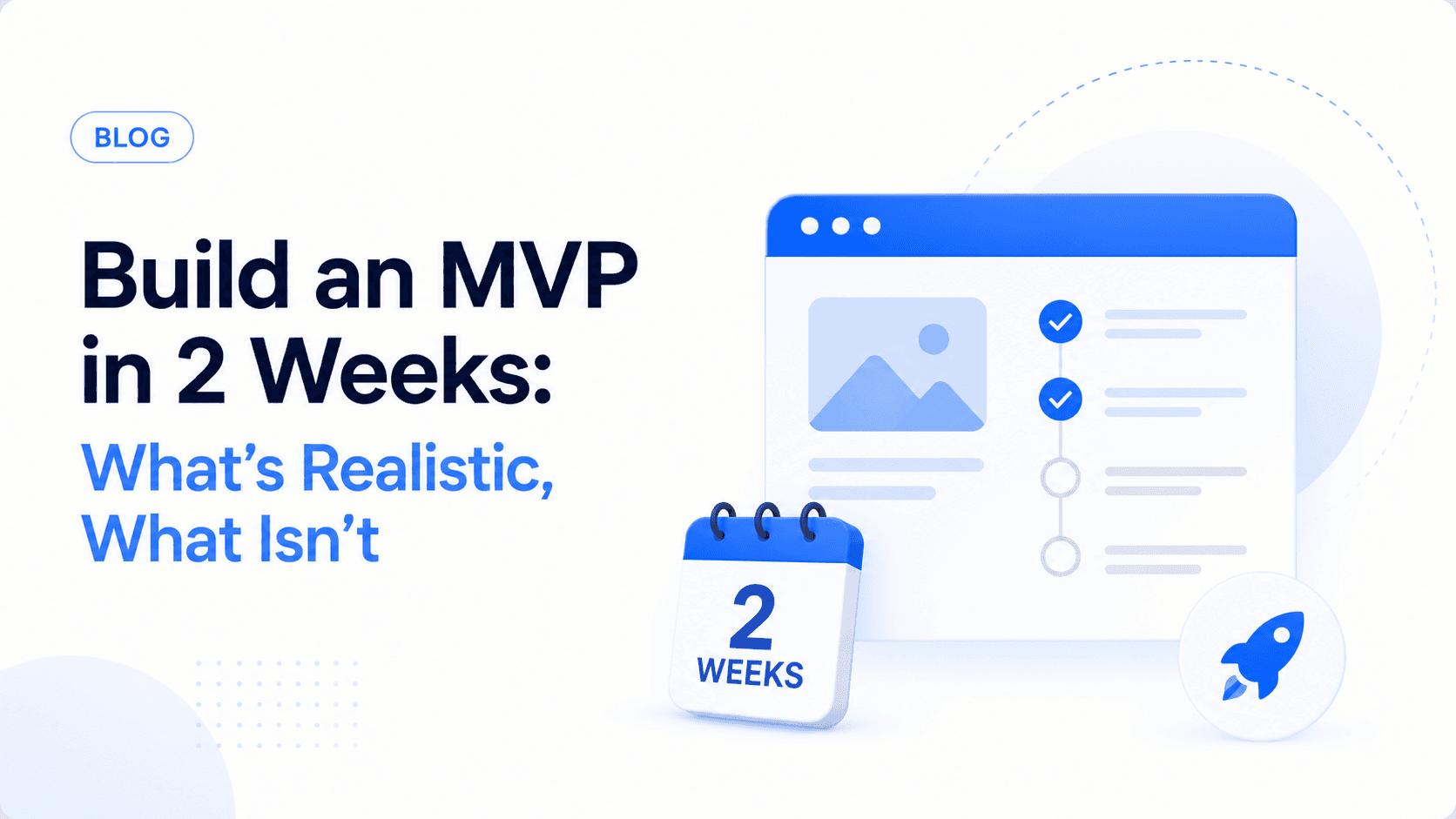
You can build an MVP in 2 weeks, but only if everyone is honest about scope. Two weeks is enough to validate a focused workflow. It is not enough to build a polished platform with every edge case solved.
The goal is not to ship everything. The goal is to ship the smallest product that proves the riskiest assumption.
That means a 2-week MVP is not a smaller version of the final product. It is a focused test. The best MVPs are intentionally narrow, useful to a specific user, and instrumented well enough to tell you what to do next.
What is realistic in two weeks?
A strong 2-week MVP usually includes:
- One primary user role
- One core workflow
- Basic authentication
- A simple database model
- Payment or lead capture if it is essential to validation
- A clean enough UI for real users
- Analytics on the key action
Examples we would consider realistic:
- A booking flow for one service category
- A marketplace waitlist with vendor onboarding
- A SaaS dashboard with one automation
- An AI chatbot trained on a narrow knowledge base
- A lead capture funnel with CRM integration
These are realistic because they have a clear user, a clear action, and a clear success signal. You can build, test, and learn without solving the entire business on day one.
What a 2-week MVP should prove
Before the sprint starts, decide which assumption you are testing.
Common MVP assumptions:
- Users will sign up for this offer
- Buyers will submit qualified leads
- Vendors will onboard themselves
- A workflow can be automated enough to save time
- Customers will pay for a specific feature
- Internal teams will use the tool instead of spreadsheets
If the MVP cannot prove or disprove an assumption, it is probably just a demo. Demos can be useful for fundraising or sales, but they should not be confused with product validation.
What is not realistic?
These are usually too much for a 2-week sprint:
- Multiple user roles with complex permissions
- Full mobile apps plus web dashboard
- Custom admin panels for every workflow
- Deep AI agents with many tool integrations
- Enterprise-grade audit logs and compliance
- Complex billing with many plan rules
Other common traps:
- Building for every user type at once
- Adding admin controls before the first workflow is proven
- Designing for scale before any usage exists
- Connecting too many third-party APIs
- Adding AI where a simple form or workflow would validate faster
- Treating launch polish as more important than learning
How to cut scope without weakening the MVP
Good scope cuts preserve the core learning goal. Bad scope cuts remove the thing you were trying to validate.
Good cuts:
- Use one role instead of three
- Start with one payment plan
- Use manual approval behind the scenes
- Launch with one geography or customer segment
- Use an existing admin tool instead of building a custom dashboard
- Integrate one critical API instead of five
Bad cuts:
- Removing analytics
- Skipping basic error handling
- Hiding unclear UX behind manual support
- Launching without the core action working end to end
- Building only static screens when the risk is workflow behavior
Our 2-week MVP sprint process
Days 1-2: Scope and product map
We define the user, the core job, the success metric, and what can be safely deferred.
This is where most MVPs are won or lost. If the scope is vague after day two, the sprint will turn into rushed guessing.
Days 3-5: Design and data model
We create the key screens, database schema, API contracts, and integration plan.
The design phase should focus on the path users must complete, not every possible future screen. Wireframes, data states, and empty states matter more than visual polish at this stage.
Days 6-10: Build the core workflow
Engineering focuses on the path that proves the business case. Everything else is secondary.
By the end of this phase, the product should be usable internally. It may still need QA, copy edits, and edge-case handling, but the main workflow should be real.
Days 11-12: QA and launch hardening
We test authentication, validation, error handling, mobile layout, analytics, and deployment.
For MVPs, QA should prioritize the core path, signup/login, data saving, payment or lead capture, mobile responsiveness, and the analytics event that proves the key action happened.
Days 13-14: Handoff and next sprint plan
You get a working product, docs, a demo, and a prioritized backlog based on what was intentionally left out.
The backlog is important. A good 2-week sprint should produce both a product and a clearer roadmap.
What you should have ready before the sprint
You can move much faster if these are ready before day one:
- Target user and use case
- Success metric
- Brand basics or design references
- Required integrations
- Example data
- Content or copy for key screens
- Payment, CRM, calendar, or email access if needed
- Decision maker availability during the sprint
The biggest delays usually come from unclear decisions, missing credentials, or late changes to the core workflow.
What deliverables should you expect?
A serious 2-week MVP sprint should leave you with more than a clickable prototype.
Typical deliverables:
- Working web app or workflow
- Deployed staging or production environment
- Authentication if needed
- Database schema and core API routes
- Analytics on the key action
- Basic error handling
- Responsive UI for key screens
- Documentation and handoff notes
- Backlog for the next sprint
Depending on the product, this may also include payment setup, email flows, CRM integration, or AI/RAG configuration.
How much does a 2-week MVP cost?
Pricing depends on scope, design depth, integrations, and how much product strategy is needed. A focused 2-week MVP is usually less expensive than a full product build because it avoids broad platform work.
Cost increases when the MVP includes:
- Complex permissions
- Multiple dashboards
- Deep third-party integrations
- AI workflows with evaluation requirements
- Payments with custom plan rules
- Marketplace logic
- Heavy data migration
The best way to keep cost controlled is to define one workflow and one success metric before the sprint starts.
The right MVP mindset
A 2-week MVP should answer one question: should we keep investing?
If the answer is yes, the next sprint can add depth. If the answer is no, you saved months of time and budget.
How to evaluate the MVP after launch
Do not judge the MVP only by whether every feature idea made it in. Judge it by whether it created real signal.
Look for:
- Did users complete the core action?
- Did leads or signups match the target profile?
- Did users understand the value without a long explanation?
- Did the workflow save time or create revenue potential?
- Which manual steps appeared behind the scenes?
- What did users ask for repeatedly?
- What should be built, removed, or simplified next?
This turns the MVP into a decision tool instead of just a first release.
Want a realistic MVP scope?
Bring us your idea and constraints. We will help you decide what belongs in the first two weeks, what can wait, and what would make the project risky. Book a sprint scoping call with Ownex Labs.