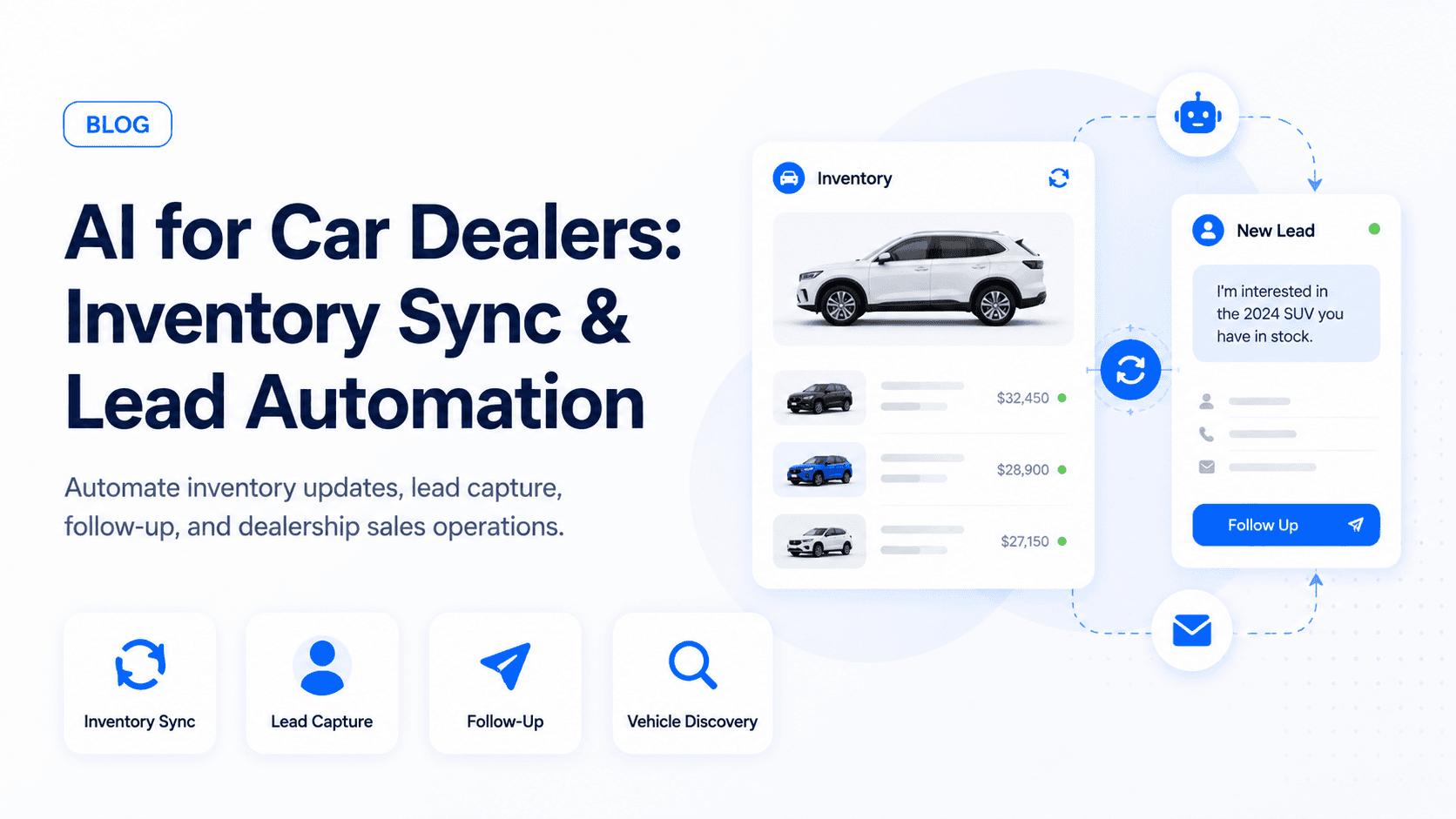
Car dealerships run on fast-moving inventory and fast follow-up. AI can help with both.
The strongest AI for car dealerships use cases are not futuristic. They are practical: sync inventory, respond to leads, qualify buyers, and reduce manual admin.
For most dealers, the value is not "AI replacing salespeople." The value is speed, consistency, and cleaner data. Buyers get answers faster. Sales teams get better context. Managers get fewer gaps between the website, CRM, marketplace listings, and showroom reality.
Inventory sync
Dealers often list vehicles across websites, marketplaces, CRMs, and internal systems. Manual updates create stale listings, duplicate work, and missed leads.
AI-assisted inventory workflows can:
- Import listings from dealer systems
- Normalize vehicle data
- Detect missing fields
- Generate descriptions
- Flag stale or duplicate listings
- Publish updates across channels
This keeps buyer-facing listings accurate without constant manual cleanup.
Better vehicle data quality
Inventory automation works best when the vehicle data is clean. AI can help standardize messy listing details before they reach customers.
Common cleanup tasks:
- Convert inconsistent trim names into a standard format
- Detect missing mileage, year, VIN, fuel type, or transmission fields
- Rewrite low-quality descriptions into buyer-friendly summaries
- Tag vehicles by body type, budget, use case, and buyer intent
- Flag mismatches between photos, title, and structured fields
This matters because buyers rarely search the exact way a dealership stores inventory internally. A customer might ask for "a reliable family SUV under 30k," not a specific stock number. Better metadata makes that kind of discovery possible.
AI-powered vehicle discovery
A dealership AI assistant can help buyers explore inventory conversationally:
- "Show me automatic SUVs under $25k"
- "Do you have fuel-efficient cars for daily commuting?"
- "What is similar to this Corolla but cheaper?"
- "Which vehicles are good for a family of five?"
- "Can I see cars with low mileage and financing options?"
The system should translate these questions into structured inventory filters, retrieve matching vehicles, and explain why each result fits. That is more useful than a chatbot that only repeats listing descriptions.
Lead capture and qualification
AI can respond when a buyer asks about availability, financing, trade-ins, test drives, or similar vehicles.
A useful dealership AI should capture:
- Desired make and model
- Budget range
- Financing preference
- Trade-in details
- Timeline to buy
- Location and contact preference
The goal is to give sales teams cleaner leads, not replace the relationship.
CRM handoff and sales context
Lead automation becomes much more valuable when it connects to the dealership CRM. Instead of sending a generic "new lead" notification, the system should pass structured context.
A useful CRM handoff includes:
- Vehicle viewed or requested
- Matching alternatives shown
- Buyer budget and financing intent
- Trade-in information
- Preferred contact channel
- Conversation transcript
- Urgency score or buying timeline
- Suggested next action for the salesperson
For example, a salesperson should be able to open the CRM and see: "Buyer is looking for a used SUV under $28k, prefers monthly payments, has a 2018 Civic trade-in, wants a test drive this weekend." That is a much better starting point than a name and phone number.
Automated follow-up
Many dealership leads go cold because follow-up is slow or inconsistent. AI can draft or send follow-ups based on vehicle interest, availability, and buyer stage.
Examples:
- "This car is still available"
- "Here are three similar SUVs under your budget"
- "Would you like to book a test drive?"
- "Your trade-in estimate is ready"
WhatsApp, SMS, and email workflows
In many markets, dealership conversations happen outside the website. Buyers ask questions through WhatsApp, Facebook Messenger, Instagram, SMS, or marketplace inboxes.
AI can help by keeping those channels consistent:
- Reply instantly when a buyer asks if a vehicle is available
- Ask qualifying questions before routing to sales
- Send vehicle links, photos, and key specs
- Remind buyers about test drives
- Notify sales when a lead is high intent
- Keep a record of conversations inside the CRM
The important detail is consent and control. Automated messages should respect local communication rules, opt-outs, and dealership preferences. High-intent or sensitive conversations should move to a human quickly.
Trade-in and financing pre-qualification
AI can make early trade-in and financing conversations smoother without pretending to be a final decision maker.
For trade-ins, the assistant can collect:
- Make, model, year, and trim
- Mileage
- Condition
- Accident history
- Photos or inspection notes
- Loan payoff status, if relevant
For financing, it can ask about budget, down payment range, preferred monthly payment, and whether the buyer wants to speak with finance. The goal is pre-qualification and routing, not final approval.
What not to automate first
Not every dealership workflow should be automated on day one. Start with low-risk, high-volume work.
Avoid automating these too early:
- Final price negotiation
- Binding financing promises
- Legal disclosures
- Vehicle condition guarantees
- Refunds or cancellations
- Anything that changes customer records without review
The first version should make the sales team faster. It should not create liability by making commitments the dealership cannot honor.
A practical rollout plan
Phase 1: Clean inventory and lead capture
Connect your inventory source, normalize listing data, and capture website leads with structured buyer intent.
Phase 2: Add AI-assisted follow-up
Draft responses, suggest similar vehicles, and route qualified buyers to the right salesperson.
Phase 3: Connect CRM and messaging channels
Sync conversations, lead scores, and next actions across CRM, WhatsApp, SMS, and email.
Phase 4: Add deeper automation
Once the basics are reliable, add test-drive scheduling, trade-in intake, financing pre-checks, and performance dashboards.
Metrics to track
Dealership AI should be judged by business outcomes, not by how many messages it sends.
Track:
- Lead response time
- Percentage of leads with complete qualification data
- Test drive bookings
- Marketplace-to-CRM sync accuracy
- Stale listing rate
- Salesperson follow-up time
- Conversion from inquiry to appointment
- Revenue influenced by AI-assisted leads
CarZoomo proof point
We built CarZoomo as an AI-powered automotive marketplace connecting buyers with verified dealerships. The platform focuses on intelligent vehicle discovery, dealer inventory synchronization, and structured lead distribution.
That experience shaped how we think about dealership automation: the system must support real dealer operations, not just generate flashy search results.
CarZoomo also showed us that automotive AI needs both sides to work: buyers need better discovery, and dealers need better lead quality. If one side is weak, the marketplace or dealership workflow breaks down.
How to start
Start with one workflow: inventory sync, lead qualification, or follow-up. Connect the systems that matter most, measure response time and lead quality, then expand.
If you run a dealership or automotive platform, contact Ownex Labs to scope an AI workflow around your current sales process.