Founders often ask whether they need RAG or fine-tuning. The short answer: most products should start with RAG. Fine-tuning is useful, but usually for behavior, format, or domain style rather than fresh knowledge.
This guide explains RAG vs fine-tuning in product terms.
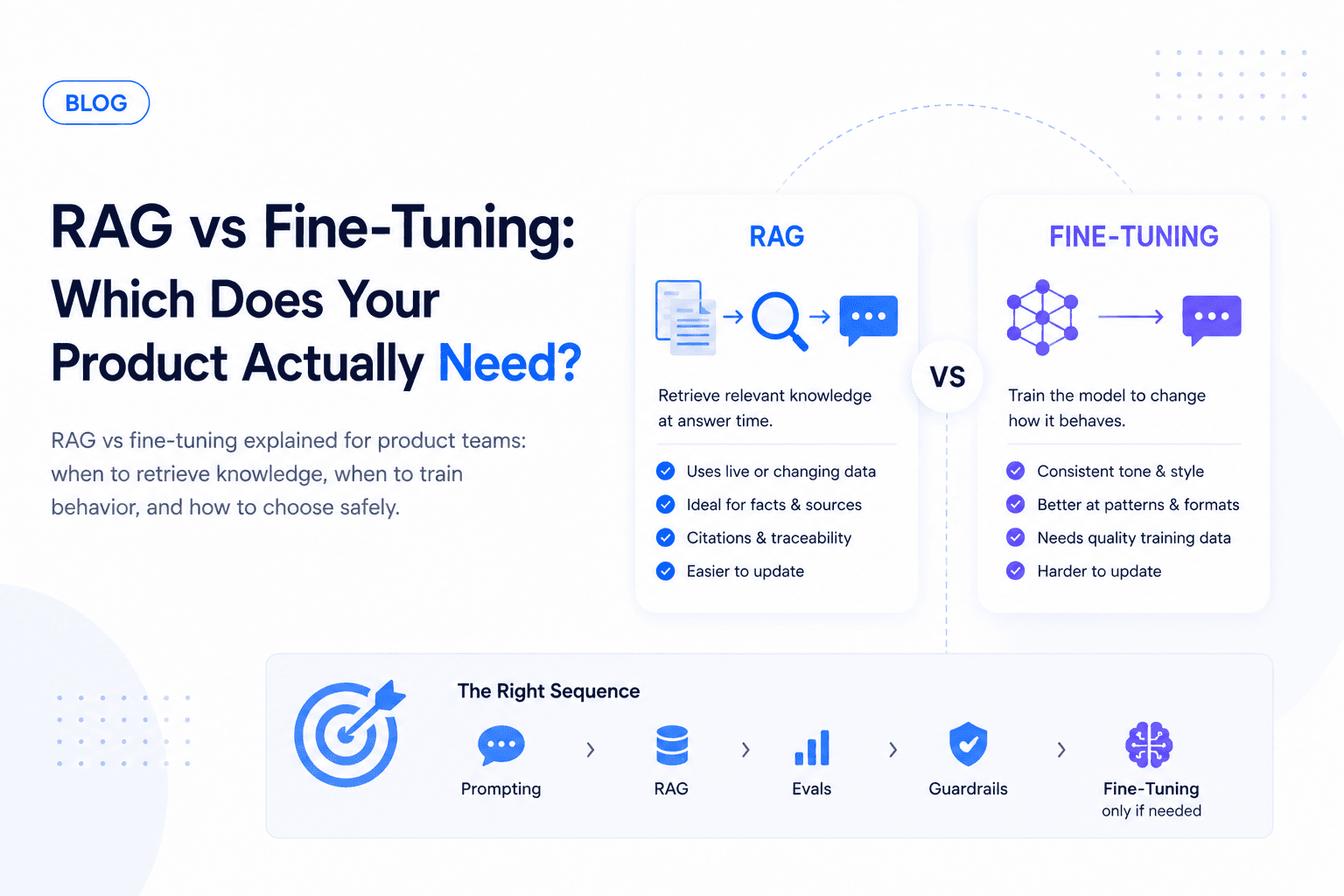
The confusion comes from treating both as ways to "make the model smarter." They solve different problems. RAG gives the model the right information at runtime. Fine-tuning teaches the model a more consistent behavior from examples.
What RAG is best for
RAG stands for retrieval-augmented generation. It gives the model relevant context at answer time.
Use RAG when your product needs to answer from:
- Help docs
- Customer records
- Policies
- Product catalogs
- Contracts
- Internal knowledge bases
- Frequently changing data
RAG is the right choice when facts change often or must be traceable to a source.
Common RAG use cases:
- Customer support assistants
- Internal knowledge search
- Legal or policy Q&A
- Product documentation chat
- Account-aware SaaS assistants
- Sales enablement search
- Marketplace or catalog discovery
RAG works well because you can update the source documents without retraining the model. If your refund policy changes today, you update the policy source and retrieval layer rather than training a new model.
How a RAG system works
A basic RAG pipeline has a few moving parts:
- Collect trusted documents or records
- Split them into useful chunks
- Create embeddings or searchable indexes
- Retrieve relevant chunks for a user's question
- Ask the model to answer from those chunks
- Show citations or source references
- Escalate when the retrieved evidence is weak
RAG is not only for documents. It can retrieve rows from a database, customer records, product listings, tickets, transcripts, or structured policies as long as permissions are handled correctly.
What fine-tuning is best for
Fine-tuning changes how a model behaves by training it on examples.
Use fine-tuning when you need:
- Consistent tone
- Strict output style
- Domain-specific language patterns
- Better classification
- Better extraction from repeated formats
- Lower prompt length for repeated tasks
Fine-tuning is not the best way to inject constantly changing product knowledge.
Good fine-tuning use cases:
- Classifying support tickets into known categories
- Extracting fields from repeated document formats
- Rewriting responses in a consistent brand tone
- Converting messy inputs into a strict schema
- Matching a specific writing style
- Reducing long prompt instructions for high-volume tasks
Fine-tuning is strongest when the task is stable, repeated, and easy to score. If the task changes every week, fine-tuning can become expensive to maintain.
Side-by-side comparison
| Question | RAG | Fine-tuning |
|---|---|---|
| Best for | Knowledge and facts | Behavior and format |
| Updates | Change documents or data source | Train or update examples |
| Citations | Easier to provide | Not built in |
| Private data | Works with permission-aware retrieval | Risky unless training process is controlled |
| Fresh knowledge | Strong fit | Poor fit |
| Consistent output style | Helpful, but prompt-dependent | Stronger fit |
| Maintenance | Source and retrieval quality | Dataset, training, and model versions |
Cost and maintenance tradeoffs
RAG costs usually come from:
- Embedding documents
- Vector database or search infrastructure
- Retrieval calls
- Longer prompts with retrieved context
- Document cleanup and indexing
Fine-tuning costs usually come from:
- Preparing high-quality examples
- Training runs
- Evaluating model changes
- Maintaining datasets
- Re-training when behavior or format requirements change
RAG often feels more operational because you manage content. Fine-tuning feels more ML-heavy because you manage examples, training, and regression testing.
The common mistake
Teams fine-tune too early because it sounds more advanced. Then they discover that every policy update, new document, or product change creates a maintenance problem.
For most SaaS and business apps, the right sequence is:
- Prompting
- RAG
- Evals
- Guardrails
- Fine-tuning only if repeated behavior still fails
Another mistake is using RAG when the real problem is inconsistent behavior. If the model has the right facts but keeps formatting responses incorrectly, retrieving more documents will not fix the output style.
When RAG is the wrong tool
RAG is not always the answer.
Avoid relying only on RAG when:
- The task is pure classification
- The model already has the facts but cannot follow the desired format
- You need very low latency and retrieval adds too much overhead
- Your documents are too messy to retrieve reliably
- The output must match a strict style every time
In those cases, prompting, structured outputs, fine-tuning, or custom rules may be better.
When fine-tuning is the wrong tool
Fine-tuning is usually the wrong choice when:
- Knowledge changes often
- You need citations
- You do not have enough examples
- The product policy is still changing
- You cannot measure improvement
- The real issue is missing context
- The workflow needs private, per-user data
Do not fine-tune on customer-specific information just to make answers "know" customer data. Retrieve that data safely at runtime instead.
Can you use both?
Yes. Many production systems use RAG for knowledge and fine-tuning for behavior. For example, a support assistant might retrieve account policy from docs while using a fine-tuned model to classify ticket urgency.
A hybrid architecture might look like this:
- RAG retrieves the relevant policy, account record, or product document
- The base model writes the answer using citations
- A fine-tuned classifier labels urgency or intent
- Structured output validates the final response
- Human handoff triggers for risky cases
This keeps facts fresh while making repeated workflow decisions more consistent.
Examples by product type
| Product | Better starting point | Why |
|---|---|---|
| Help center chatbot | RAG | Answers need current docs and citations |
| Support ticket classifier | Fine-tuning or few-shot prompting | Categories are repeated and measurable |
| SaaS account assistant | RAG | Answers depend on live customer data |
| Brand voice reply writer | Fine-tuning | Style consistency matters more than facts |
| Legal policy Q&A | RAG | Sources and citations matter |
| Invoice field extraction | Fine-tuning | Repeated structured extraction task |
Build evals before choosing
The best way to decide is to test both approaches on real examples.
Create an eval set with:
- Questions that require fresh documents
- Questions that require exact formatting
- Ambiguous requests
- Missing-source cases
- Private-data cases
- Examples where the model should refuse
- Examples that need classification or extraction
Score:
- Correctness
- Grounding
- Citation quality
- Format reliability
- Latency
- Cost per successful task
- Failure modes
If RAG improves factual accuracy but output format remains inconsistent, consider fine-tuning or stricter structured outputs. If fine-tuning improves tone but still gets facts wrong, add retrieval.
How to decide
Ask these questions:
- Does the answer depend on private or changing data?
- Do you need citations?
- Is the problem factual or stylistic?
- Do you have enough high-quality examples to train?
- Can you measure improvement with evals?
If the answer depends on live or changing data, start with RAG.
Use this rule of thumb:
- Need current knowledge? Use RAG.
- Need citations? Use RAG.
- Need private account data? Use permission-aware RAG.
- Need consistent style? Consider fine-tuning.
- Need repeated classification? Consider fine-tuning.
- Need both facts and behavior? Use both.
A practical rollout plan
Phase 1: Prompt and structure
Start with a strong prompt, structured outputs, and a small eval set. This is the fastest way to understand the real failure modes.
Phase 2: Add RAG
Connect trusted documents or data sources when answers need current knowledge or citations.
Phase 3: Improve retrieval quality
Tune chunking, metadata, filtering, permissions, and source freshness before assuming the model is the problem.
Phase 4: Fine-tune narrow repeated tasks
Only fine-tune once you have enough examples, stable requirements, and evals that prove the improvement is worth maintaining.
Need help choosing?
Ownex Labs designs RAG systems, evals, and fine-tuned workflows for production AI products. Send us your use case, and we will help you choose the right architecture.